In real production, I’ve seen perfectly coated parts come out looking dull, soft, or uneven. The coating was applied correctly, but the curing process failed. What actually happens is that without proper curing, the powder never forms a strong bond with the metal surface. It just sits there as a weak layer that can easily fail during use.
A curing oven is where that loose powder turns into a durable, hard, and smooth finish. It is not just about heating the part. It is about controlling temperature, time, and airflow so that the coating reacts exactly the way it should.
What Happens Inside a Curing Oven During Powder Coating?
Once the coated component enters the curing oven, the process starts almost immediately. The oven raises the temperature of the metal part, not just the surrounding air. This detail is often misunderstood.
One common issue I’ve seen is operators focusing only on oven temperature instead of metal temperature. The oven may show 180°C, but the part itself might still be much cooler, especially if it is thick or heavy. This leads to under-curing.
As the part heats up, the powder coating begins to melt. At first, it looks slightly glossy as the particles soften and start to flow. Then it levels out across the surface. What actually happens next depends on the type of powder being used.
In thermoset powder coatings, which are most common, a chemical reaction begins. The melted powder starts cross-linking at a molecular level. This forms a solid, tightly bonded network that gives the coating its strength, chemical resistance, and durability.
If the process is done correctly, the result is a uniform, hard coating that can handle wear, corrosion, and environmental exposure.
Why Temperature Control Matters in a Curing Oven
Temperature control is everything in a curing oven for powder coating. Even a small variation can affect the final finish.
In real production, I’ve noticed that uneven airflow inside the oven creates hot and cold zones. Parts placed in different areas of the same batch can cure differently. Some come out perfect, while others remain slightly soft or discolored.
This happens because curing depends on both temperature and time. Most powder coatings require the metal temperature to reach around 160°C to 200°C and stay there for a specific duration. If the temperature is too low, the coating does not fully cure. If it is too high, the coating can burn, lose gloss, or change color.
Good curing ovens use forced air circulation to maintain uniform heat distribution. This ensures every part inside the chamber receives consistent heating, regardless of its position.
The Real Stages of Powder Coating Cure
From a practical standpoint, the curing process follows a sequence, even though it happens smoothly inside the oven.
At first, the powder melts and turns into a liquid-like film. Then it flows across the surface, filling small gaps and smoothing out irregularities. After that, the chemical reaction begins, and the coating starts to harden.
One thing I’ve observed is that operators sometimes remove parts too early because the surface looks finished. But appearance can be misleading. The internal cross-linking may still be incomplete, which leads to weak adhesion.
Proper curing always depends on achieving the required metal temperature and holding it long enough for the reaction to complete.
Types of Curing Ovens Used in Powder Coating
Different production setups use different types of curing ovens, depending on volume and part size.
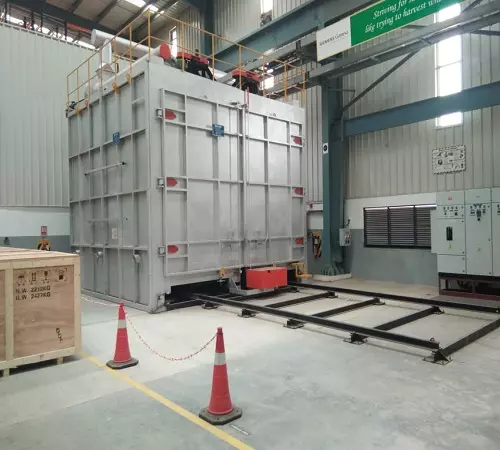
In batch operations, manufacturers often use box-type ovens. These are suitable for handling large or heavy components where flexibility matters more than speed. You load the parts, run the cycle, and unload once curing is complete.
In high-volume production lines, conveyor-based ovens are more common. Parts move continuously through the oven, which allows consistent throughput and better efficiency.
In some cases, infrared heating is used for faster curing. This method heats the surface quickly, but it does not always penetrate deeply into thick components. That’s why many systems combine infrared and convection heating to balance speed and uniformity.
Common Problems in Powder Coating Curing
Even with good equipment, curing issues still occur if the process is not controlled properly.
One common issue I’ve seen is under-curing. The coating looks fine initially, but it fails during testing or real use. It may scratch easily or peel off. This usually happens when the metal temperature never reaches the required level.
Over-curing is another problem. When parts stay in the oven too long or at too high a temperature, the coating can become brittle or discolored. This affects both appearance and performance.
Airflow imbalance also creates problems. Poor circulation leads to uneven curing, especially on complex parts with cavities or hidden areas.
These issues are not always obvious during inspection, which is why many manufacturers rely on temperature profiling tools to monitor the actual heat cycle of the part.
How Curing Ovens Improve Coating Quality
A properly designed curing oven does more than just heat parts. It ensures repeatability.
In real production, consistency is the biggest challenge. You may get perfect results in one batch and inconsistent results in the next if the process is not controlled.
A well-designed system maintains stable temperature, balanced airflow, and precise timing. This ensures that every coated part meets the same quality standards.
Manufacturers like JR Furnace focus heavily on these aspects because coating performance depends directly on curing accuracy. Even a small variation can affect adhesion, finish quality, and long-term durability.
Practical Factors That Affect Curing Performance
Several real-world factors influence how well a curing oven performs in powder coating processes.
The size and thickness of the component play a major role. Larger parts take longer to reach the required temperature. If the cycle time is not adjusted, the coating may not cure properly.
The type of powder coating also matters. Different formulations require different curing temperatures and times. Using the wrong settings can lead to poor results.
Loading pattern inside the oven is another factor. Overloading restricts airflow and creates uneven heating. I’ve seen cases where simply rearranging parts inside the oven improved curing consistency without changing any other parameter.
Even ambient conditions can have an impact. Heat loss from the oven or fluctuations in surrounding temperature can affect performance if the system is not properly insulated.
Why Curing Ovens Are Critical in Powder Coating Processes
At the end of the day, the curing oven is what determines whether a powder-coated part succeeds or fails in real use.
Applying powder is relatively straightforward, but curing requires precision. It demands control over temperature, time, and airflow, all working together.
In real production, the difference between a high-quality finish and a rejected batch often comes down to how well the curing process is managed. That is why manufacturers invest in reliable curing ovens and pay close attention to process parameters.